

The South of the South: An Interview With a New Voice, Ian Hall, About His Debut Collection CREEKWATER MANSIONS

Creekwater Mansions | EastOver Press | $19.99
Ian Hall’s debut collection Creekwater Mansions is a book with heft, literally and figuratively. At 140 pages of poetry, complete with Appalachian colloquialisms and references to French philosophers, Hall melds the sacred and profane effortlessly as his speakers battle bellyaches in outhouses and praise the piety of their mothers. All the while, Hall writes in a voice and timbre so genuine that we feel as though we’re riding shotgun with windows down as he takes us on an honest tour of his old holler.
I interviewed Hall to discuss tradition, public versus private personas, and the impact that poetry can have on an environment.
William Brown: Stemming from the cover with Van Gogh’s Siesta on there, throughout the collection you reference theories, philosophers, art and various thinkers. What kind of exposure did you have growing up in terms of poetry, but also the kind of like the capital A art in a sense?
Ian Hall: So my parents were both teachers. My dad passed away, but my mom still is a teacher. But it's funny because most of the rest of the family works in blue collar. And even if they've professionalized in blue collar, they still work in blue collar fields. Like one of my uncles has been a mining engineer for forever. Coal mining is and was the be all end all out in that neck of the woods. But for me, I came up in a very literate household. There was a lot of reading. Poetry didn't really feature very largely in it, but my mom has always been a voracious reader and she really instilled that in me. My dad wasn't a diehard, but you've probably seen the New York Times stuff that says if you read a book a year, you're reading more than like 99% of the population, so he'd be a bibliophile in today's world. What I got from my dad probably was a love of movies. I could watch, much to my wife's chagrin, twenty movies a day.
I started with reading the Sherlock Holmes mysteries and James Bond books when I was probably 10, 11, 12. I was probably a teenager when I really fell in love with sort of literature, capital L, so to speak. Raymond Carver was huge for me. There was a lot of that culture of mixing high and low. That's my obsession, this sort of constant dialogue between the high and the low, sacred and the profane, or as they call them in The Sopranos, the sacred and the profane. Later, I zagged off into the effete world and poetry by discovering, I'm sure you had this too, that realization of poetry isn't just something people in powdered wigs and early modern England did. It's right here amongst us, David Bottoms, people like that right in our neck of the woods, in our world, doing that stuff, Shooting Rats at the Bibb County Dump. That realization that the sort of terroir of your own world is fodder for Shakespearean stuff. It was just totally enrapturing to me.
WB: It's funny you mentioned David Bottoms because there was a moment in my undergrad where I was reading a poem of David Bottoms that was in an old issue of the Georgia Review that was just like lying around at the university, and it had his poem “Disobedience” in it, and within that poem was the phrase, “rusty is a sheep turd.” It was one of those moments in which the door was just suddenly opened, and I was like, “Oh, that belongs in poetry. That has a place in poetry.” Do you have one of those door-opening moments where you had this preconceived notion of what poetry is, and then you encounter a more contemporary or rural writer, and you think, “Okay, people who sound like where I come from are also doing this?”
IH: Oh, absolutely. I've probably got a million of them. But the one that sticks out to me the most is when I was a junior in high school, or somewhere in that neck of the woods. One of my two or three favorite poets is Frank Stanford. Now that I've read a lot of his corpus, I don't think it's one of his best poems, but it's just so totemic of this thing we're talking about here. It's a poem called “Flies on Shit.” It’s a really short, little poem, and the ending lines are, “I cut my eye teeth on flies / floating in shit,” and it was like a thunderbolt through me. It was just so immediate. All of this stuff you don't really know what to do with, all this sort of substratum, inarticulable sort of churn you feel on yourself as a hormonal teenage boy. Coming upon that, you don't know what to do with any of it. The world you live in is oriented differently from the sort of world you see on the computer. You don't really know what to do with all this sort of dialectical incongruity. And that poem was sort of like planting your flag in a sense of this stuff is worthy of talking about, this stuff is worthy of discourse, worthy of being an image in high poetry, so to speak.
WB: Coming out of the rural South, what sort of like traditions do you feel like you're working out of? Also, of those traditions, is there anything that you're trying to uphold or trying to subvert or undo in a way?
IH: Absolutely. I apologize if this is sort of a meandering answer. I'm gonna have to enter it by way of backward thinking. One of my focuses in my PhD was southern poetry. There is a lot of mythos, the mythopoia, the southern swoon. I've been able to, in a kind of logistical way, parse through a lot of that, even if it's still just titillate me on an emotional register. One of the things I've really discovered there is that Appalachia is kind of precariously placed within the larger South. There's a sociologist named John Shelton Reed who worked in Southern Studies more broadly, but in one of his books about Appalachia, he says, “Appalachia is the South’s South,” which I thought was a very sort of poignant phrase. And where I'm from, there's even more bifurcations. North Georgia and East Tennessee are much different than Eastern Kentucky and West Virginia. Central Appalachia has a lot more Rust Belt connotations. It's got a lot more in the sense of labor unrest, proletarian sort of energies, because of the colonial dominance of coal there. Not that it didn't exist in mills in western North Carolina, but even going there today, you can look at them, and it's just night and day. East Tennessee and western North Carolina are gorgeous, just like North Georgia is still very preservationist of their public land. You don't see that as much in East Kentucky. It's beautiful, but it's more sort of graveyards of old corporate fiefdoms in a sense. I think that the political economy is a lot different, which means that downstream of that, in my opinion, the literary tradition is a lot different.
I'm fascinated by the entire Southern literary tradition, but in my work, I try to contend with this sort of romance of the moonlight magnolia tradition of the southern literature writ large from the vantage of someone who probably would have, amongst many others, not really been invited to it. I would have been more of a Thomas Sutpen from Faulkner. All that to say, there are layers of it for me. When I sit down to write, I don't really think of any of that kind of stuff. All the studying and research and cogitating exist outside of that. Then, it's much more line-level things that drive me when I'm writing a poem—alliteration, assonance, how does this sound. I’m horrible at scansion, but I try to do the meter, the syllabics, that kind of stuff. And then within those parameters, even when you're not working in received forms, these things that upset your obsessions find a way of playing themselves out, and you just sculpt them into something esthetic or non-esthetic.
To encapsulate, I'm absolutely enamored by or obsessed with the whole sweep of southern and Appalachian history and how they sort of have been at odds and at loggerheads and sometimes together or sometimes unified. I think if there's an aperture in which my work works critically, and again, none of this really occurs to me while I'm writing it, but if I step back and try to look at it the way I would if I'm writing a review of a book, then it would be somewhere in that kind of perch, looking at interrogating the larger southern traditions through a very central Appalachian point of view where it's different than Gone With the Wind. It's not that at all. It's, in fact, it's the polar opposite of that.
WB: Across your collection, there are quite a few persona poems, and there are also quite a few southern colloquialisms. When you’re writing, do you find yourself dialing up that register, dialing it back, or is it pretty consistent with how you would naturally speak?
IH: I had an old salt Southern literature professor, and I had to read Charles Waddell Chestnutt, George Washington Harris, the Sutt Lovegood stories, and these are all in dialect. There's a poetry to it if you really sit at it, but at first it's just so off-putting even to me, where people where I'm from literally talk like that, it's not just put on. Even still, as someone who's so ensconced in it growing up, it's just totally off-putting to a modern sensibility to sit and read a whole story that's in dialect. However, I don't want to throw the baby out with the bath water because I think one of the most unique things I'm doing is that I want to write allusive literature that talks about other things and contends with philosophy and art and cinema and things like that. The only real metaphorical system I have to talk about those things is filtering it through high Appalachian or high southern. When I put one of those really neck-jerking, whiplash-inducing colloquialisms, I'm like, “Okay, now you have to earn that to put it in.” The poem has to have a feng shui, you know. If it's all just the Beverly Hillbillies, what's the exigence for that? It’s really sort of, “Where is the human heart in conflict with itself,” as Faulkner says is marrow of all great literature. So I love using those on a line level and I love when I feel like it fits. Sometimes they come to you like you just caught a big bass in water and it's like, oh my gosh, I can't believe that's given to me. But that's very rare. Usually, it's a work job. You're really having to excavate what's worthwhile there. I think that when my poems are at their weakest, it becomes too much of that, I lean too heavily on a thing that I can do fairly well, which is fold in southernism, but it becomes all just southernism, it becomes wordplay in search of a poem. I think some of the real highlights of the poems for me personally are when you can really hit one of those colloquialisms that seems totally unexpected but perfectly situated in the mien of the poem itself.
WB: What do you think about that imposed separation of literate and working-class people, especially as it pertains to people coming from southern and/or rural areas?
IH: There's another great book by E.P. Thompson called The Making of the English Working Class. It's not all about this, but there's a huge section there about the intellectual pursuits of working people, of laboring people. And I'd had very similar experiences, all this stuff too. All through high school and college, what I did in the summers was clean horse shit. Literally, I would muck out stalls the whole time. This is probably the most unskilled, low on the totem pole, bottom rung work you could do. But at the same time, I was trying to write and publish poems and reading voraciously. So it is real. People are doing this. And it used to be even more real in a sense. I think one of the things that's been robbed from us is this idea that we can do that, that there has to be this bifurcation. There's heaps of textual evidence to the contrary, this idea that there has to be this bifurcation between the academic and the laboring, that academia is this total sort of effete, lofty, Socratic enterprise that only the children of professors can pursue. I'm always pushing against that, even though, like I said, nobody in my family is really reading Ranciére, but they have a vibrant intellectual life, even if it doesn't conform to the sort of standards of a PhD.
WB: I remember thinking that I never wanted to write poetry that, for example, the mechanics in my family wouldn't be able to understand. When you conceive of your audience, do you feel like you're writing toward a specific group or like against a specific group?
IH: What you just said is absolutely right and gave me chills even hearing you say it. I’m not pursuing obscurantism at all. Sometimes the verbal ticks that I have or the register that I'm trying to cultivate in a poem will make it where people who aren't really conversing in poetry, just the genre conventions, may not know exactly what I’m saying. But no, if I had my druthers about it, everyone would be able to understand what I was talking about in my poems. There's this great line in Thomas Wolf's Look Homeward Angel where, maybe it's Eugene Gant, talking about being a teenager and reading something and saying, “I don't have a clue what they're talking about, but I know exactly what they mean.” That is what I want. Even if you don't know the sort of ephemera of what I'm talking about, if you can see the emotive underpinning and if that can drive into you, that's all I want, to elicit an emotional response. Not like puking or crying, but to have an emotionally resonant moment. So yeah, I would love for the people at home to understand and feel my poetry. That’s who I’m loyal to.
There's this Yusef Kumunyaka poem called “Venus Flytraps” and that poem it was just totally electrifying to me when I read that. There’s a lot of that John Donne kind of yoking of images together where it's like almost non sequiturs, but it's in the same tonal register. I had no vocabulary to describe what was happening technically at that point, but it was just so, I mean, it shrinks your nipples it gives you such a cold feeling. It just is absolutely titillating to me and it was just eye-opening. I remember reading that and saying, “I want to do that. What is happening here? I want to be able to do that. I want to be able to replicate that with my own stuff.”
WB: You write about company towns and coal country in general, which is so rough for a variety of reasons. Do you have any notions of what poetry can do in terms of assisting an environment, a location, an ideology?
IH: I'm double-minded about it. There is this argument between the sort of Bertolt Brecht school and the György Lukács school. As Brecht says, you should defamiliarize and make people uncomfortable when they approach your stuff. And in the act of making them uncomfortable, you will catalyze and give them consciousness, eco-consciousness, class-consciousness, these kind of things. You will make them aware of these things that were otherwise veiled to them. You will inspire them to then pursue their own sort of, as the quote goes, ruthless criticism of everything existing. And then there's the sort of Lukácsian school that says that the better model is realism. It doesn't matter what your political alignment is, even if you're a royalist like Balzac or Stendahl, if you are accurately and honestly portraying these tensions between different interest groups in society, then people will read that and they'll see the honesty and then they'll get the same response. You don't have to be intentionally off-putting. It's funny for being such materialist politically, I don't feel the same way artistically about it. The goal is always to produce the truest and most honest-to-the-vision piece of writing that I can.
But speaking to like the what the potential power of it is, I think in a way it does have to work on people if it can work at all in a sort of hearts and minds kind of liberalism way where that emotional response you're talking about eliciting, if you can do that in one person and then it can move on to another person, then there's a couple people that may have a change of heart or a change of opinion or a change of view on things. I think it can work similarly to the way that songs work. In coal country, for example, there are all these folk songs that have become rallying cries for land justice. A lot of these old company towns are still owned by the same people. They still own the mineral rights, they still own the land. So even though it's just sitting there as a graveyard this graveyard, there’s been no sort of repatriation. There's been no sort of reform. The land justice has not happened in a sense. It's just sitting as a decrepit, crepuscular monument to colonial land tenure. But from a further, zoomed-out view, I think that it is the emotional impact you can spring from someone that’s a large part of it. These things can become rallying cries. The Union song “Which Side Are You On” which was so big coming out of Harlan County in the 1930s, was written by a woman on her wallpaper after she learned her husband had been jailed by anti-union thugs that worked for coal bosses. This sort of poetry, being twined to song, I think, is part of its power. It doesn't have to be sing-songy to have the effect of song.
There’s a poetry critic named David Orr who wrote a book called Beautiful and Pointless, and it talks about all these grand declarations about what a poem can do or what poetry can do. He says some of that is true and possible, but he argues that really, what studying poetry does is make you a better, more equipped appreciator of poetry. I believe poetry can have these other downstream knock-on effects, but all of that is secondary to reading poems makes you a better reader of poems. I’m of two minds about it in that sense.
WB: In its earliest modes, poetry was an audible experience in which poems were recited and/or performed. Now there's this idea of poetry being a very private act. I was wondering how you see that relationship between like the public and the private with poetry, because we've talked a little bit about you wanting the folks back home to be able to read your poems and where you get these inspirations from, but how do you see that kind of play between the public and private as a poet kind operating, especially with there being some persona poems in your collection too—that relationship between the public poet versus the public speaker; you have speakers in these poems that doesn't always align with the poet.
IH: To first tackle that sort of public-private dichotomy, there’s this natural disposition that we are to ourselves the most interesting person of all time, and we're just not really sure why everybody else don't feel that way. I certainly have, at my worst moments, that kind of thing. We have to be who we are. We have to be in this body and this headspace. So, you know, we're obviously more focused on ourselves just by dent of that. However, something that really was kind of eye-opening for me was this really great, really short essay by Jonathan Culler called, “Why Lyric?” He's essentially asking, “Does poetry matter any more? What is it about poetry that makes it worthwhile?” He also claims something along the lines of, via the overthrow of poetry by other forms of writing, that we've lost the aspects of poetry that make it particularly poetic. The focus on the song, the singing aspect of it, the focus on the performance, the focus on the aural qualities. If you just judge it by the narratological metrics of fiction, it's gonna be less worthwhile fiction. He's says that we have to reclaim and recapture the persona. We have to reclaim and recapture these other things. And I very much was thinking about that, of course, on a line level with the oral makeup of a poem, the sonic makeup, but also with things like persona.
I love books like Edgar Lee Master’s Spoon River Anthology. These things that these would be so passe in our day, like at a workshop, and I think that's regrettable. In a way, we have been novelized in the sense that the advent of the novel is the advent of the bourgeois sensibility. It's the advent of the interior, or the interior replacing the epic model of the Greeks where society is so alike and there's not such class. The new sort of super-structural art form that addresses that is the novel, which is about the interior, it's the interiority, it's the self, it's the self interacting with other sort of floating disparate beacons. And I think that in a way what I'm trying to do some with the poems, and again, none of this happens as I’m writing, is the persona, the music, not that you could sing the poems, but the sort of play, the things that have been so discarded kind of by the mainline status quo of the arts and letters scene. I think that those things need to be re-emphasized in a sense. But I want it to be the way where you're like, “Did this actually happen or is this a thing?” I don't want useless confusion, but I want there to be a whole cast of characters. I want it to be larger in scale and scope. And then sometimes you want it to be quiet and small. Sometimes you want it to be directly the lyric I talking to you, the reader.
I think that reading Culler’s essay was really important to me to get me to start thinking about what are these aspects of things that we don't see as much in books. I'm not saying they don't exist, but Spoon River Anthology isn't the hottest thing on people's syllabus. Robert Browning persona poems are not the hottest thing on people's syllabus. I come from such a communal place. I want that and the humor and the playfulness to be reflected in the poems. These are public emotions in a lot of ways. I want the private and the public to meld. I want them to be there in a way where it's not just this sort of woe begone lyric I who confesses things and emotes all over you. Not that there’s anything wrong with that, but I think that if that's the only poetic tactic, then I so much has been lost because it's such a rich and varied tradition through the ages, you know?
WB: Creekwater Mansions is a long collection, especially in terms of other contemporary collections. The poems themselves are also often longer than what’s become standard. Out of our conversation, I’m wonder what you see as the connection between that sort of style and length and you having grown up in a rural area.
IH: You can’t get us to shut up. I've had several people say my collection is like three different books, but for me, it's always been the thing. Charles Bernstein has a funny little quip about the inscrutable poet who is entombed in academia and only comes out with a 50-page book every five years and they think they have as much to say as Karl Marx. I wanted the first book to have some heft on it. It sounds superficial, but when I pick this up, it feels like a book to me. Not that small books aren't books, but this is 140 pages, you know, it feels like a book.
You can listen to Ian Hall read some of his poems HERE

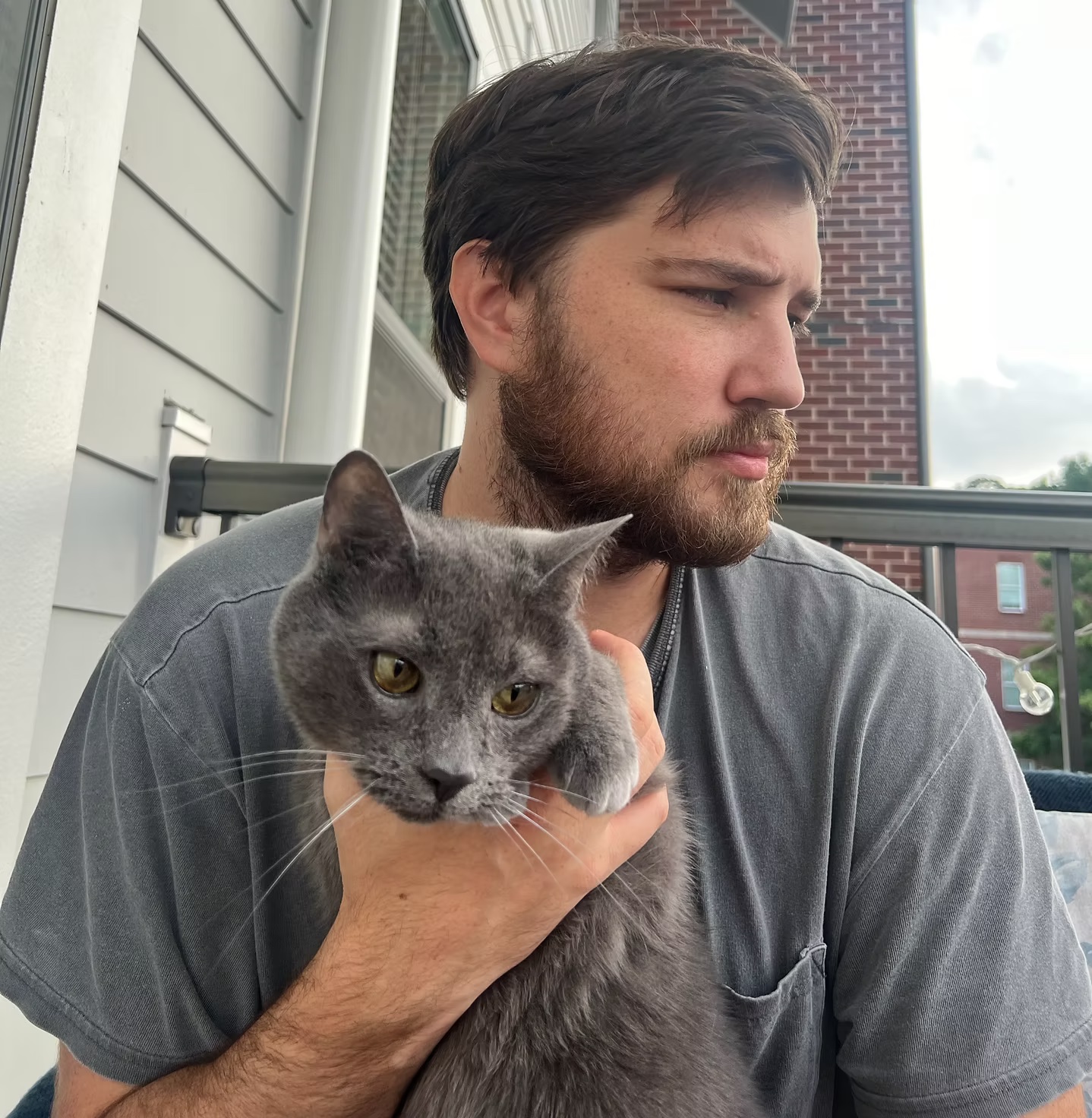
Ian Hall was born and reared in the coalfields of Southeastern Kentucky. He holds an MFA from the University of Tennessee, Knoxville, and he is currently a PhD candidate in English at Florida State University. He appeared on Narrative Magazine’s ‘30 Below 30’ list, and he was named the winner of the 2025 Princemere Poetry Prize, as well as the co-winner of the Kentucky State Poetry Society’s 2025 Grand Prix Contest, and the runner-up of the 2025 Vivian Shipley Poetry Award. He was named a finalist for the 2024 X.J. Kennedy Prize, the 2024 Tennessee Williams Poetry Prize, and the 2025 Red Wheelbarrow Poetry Prize. His work is featured in numerous publications, including Narrative, Mississippi Review, The Journal, and American Literary Review. He lives in Tallahassee, Florida.


Comments