

The Palatable Grotesque: An Interview With Chrissy Martin on Her Debut Collection WHOLE, HOLY, HOT
Updated: May 22

Whole, Holy, Hot | Write Bloody Publishing | $18
Chrissy Martin's debut poetry collection reads as a revolving mirror: witness and vanity are cast onto both the collection's subjects and the reader, spotlighting our tendency to believe that seeing is knowing. The act of looking in Martin's collection performs a coding—whether that be in language or visual markers—and what escapes our gaze is tender, warming the poems from a softer underbelly. Full of wit and wonder, Martin's collection entertains us with dazzling performances of desire, deflection, and a truly American brand of indulgence.
I sat down with Martin to talk about perception, attention, and the bodies we navigate the world with.
Whitney Koo: Whole, Holy, Hot explores disability and femininity primarily through the mechanism of pop culture, specifically how sex, or sexiness, is equated with womanhood, both to oppress and to value. When reading your collection, sexiness reads—not so much as a form of protest—but a kind of resilience and marker of desire. Do you see resiliency and desire as being compatible?
Chrissy Martin: Thank you for this question. I was thinking about sex and sexiness and desire in a few different ways, and it especially differs from poems that center the speaker and poems that center a pop culture figure. I think this comes down to pulling apart who the sexiness and desire are for, who it benefits.
In performing desirability, performing desire, or making oneself desirable for someone else—I'm thinking of poems like "Centerfolds" and "When Victoria P sat out The Bachelor Football Game"—the speaker or pop culture figure is making themself nice for someone else, whether that is an individual or the internalized knowledge of what a desirable body looks like, in particular, like a desirable female body. But on the other hand, you have poems that feature actual desire. This appears when there is an acceptance of one's bodily reality. So, while I'm a little bit hesitant to use the word “resilience” myself—I'm thinking more about learning and adapting—I would say there is a clear relationship. As the speaker gains knowledge (embodied, medical, material, geographical, sexual) about her own ill body, she can recognize and communicate desire.
So, the poem I'm thinking about is "Velvet," which was an important poem in this thread of desire. I started this poem quite a few years ago—I didn’t figure out what this poem needed until recently. I saw an image of a moose losing its winter velvet, and I couldn’t get it out of my head (a bloody, grotesque, captivating image). I liked how instinctual, unadorned, powerful, and awful it was to look at. I wanted to parallel this image with a vulnerable, intimate (unperformed) moment between the speaker and the other. To me, the “miracle” in this poem is the comfort in refusing to perform for someone else, the refusal to be made palatable, of being naturally and unselfconsciously in your body, next to someone else who is doing the same. It’s a little animalistic and a little gross. To me, that is the moment where resilience and desire are intertwined.
WK: As you were talking, I started to think about how people with disability spend so much of their time preoccupied with how they are going to be looked at by others, as grotesque or as palatable, which frames how they navigate the world. At the same time, the desire not to be constantly looking outward. Do you feel like the collection actively negotiates modes of looking—of looking outward and looking inward, or escaping the ability to be "viewed"?
CM: I try to show both of those. I hope that when I'm showing the preoccupation with the outer world, there is an implied critique, showing that constant preoccupation, paranoia, of “How am I appearing to others? How am I making myself palatable to others? How am I making myself not marked as other?” I try to have these core moments in the book where the speaker or maybe a pop culture figure is letting loose in a way that is, I mean, “gross” is a simple word, but kind of gross. Reacting instinctively and reacting for one's own desire and not thinking about how they look from the outside. And as I'm saying this, I'm thinking about the fact that a lot of those poems happen in the dark. So, the looking can't happen, right? It's not only not thinking about how your body appears to others, or if thinking if you are acting in a normative way, but how do I feel in my body in this moment right now?
WK: We can think of pop culture figures in these moments as spectacles. And when we're talking about disability, there is a similar sense of being seen as a spectacle as opposed to a person. As you were writing about some of these pop culture figures, how were you strategizing a way of doing so that felt ethical? Because I think when we think of pop culture as a study, we're thinking about the dehumanization of these individuals.
CM: When I first started writing pop culture poems, it took me a while to sort of figure out how to do this in a way that felt natural and felt ethical. I found that at first I was using this figure just as an entry point to talk about myself, which felt exploitative, right? It felt like the same thing I was critiquing. So, one thing I did was I made sure that they remained in the entire poem. I ended up implicating myself because I'm part of the audience who is like jeering, and part of the audience that's thinking, Oh my gosh, this is so ridiculous. I'm thinking of this person as a spectacle. So, I try to implicate myself in the poems, in the moments where I was part of the audience. I also tried to do quite a bit of research on the persons themselves to understand them more. One of my poems, "Centerfolds," was accepted by swamp pink, and then I added a little bit to the poem because it felt like I was being unfair to Ellen Stohl, who is the first disabled model in Playboy. There was an interview that she did in her Playboy issue where she equated being sexually harassed with being treated like a woman in a sexual capacity. And I, by happenstance, found a YouTube video where she was speaking from a more adult position. So, I added the lines that included her adult self reflecting back. My attempt with that was to not critique her, but to critique the way that we are taught to think about our bodies and womanhood. To show her as an adult with a knowing voice. That's something that I continue to try to negotiate, and I hope that I've done so in an ethical way, but it's something that remained on my mind throughout the entire writing and revising of the book.
WK: Okay. And so hot. We see it in the title, and it appears constantly throughout the collection. At times, it refers to hot as temperature, and at other times it refers to hot as a type of appearance or idea (cue Paris Hilton). I find myself most taken by hot's appearance as a flare: the body flares to cite disease, while in other areas, we are reading about actual flares that you’d use in a rescue mission. I think of flares as outward attempts to gain attention, good or bad, and I wonder how attention as an idea operates in the book.
CM: I love this question. So, in the book, hot began as literally hot—as heat is the thing that alleviates my pain—and continued to evolve. In “Flare,” (with the road flares), I was trying to articulate the (nearly) impossible to articulate experience of a flare-up. While it began as an attempt to explain and be understood, it dipped into considering attention as both healing and harmful: “Flare. Not to be confused with a flare gun, as in help me, I am lost. As in when I am the most vulnerable, I am told to send up fire so that I can be found. As in it’s better to be found by the wrong person than not at all.”
The book oscillates between attention as positive and negative. In the pop culture poems, attention is a double-edged sword. Celebrities operate in the attention economy, which they push against and embrace. In these poems, I want to point out the expectations of performing for attention, of presenting their bodies in a way that is nice to look at—for someone else to consume.
It’s funny you mention the Paris Hilton “that’s hot” because her way of describing “hot” connects to the idea of attention and knowing: “If you don’t even know what to say, just be like, ‘That’s hot.’” and “The word hot is evocative; there’s energy in it—hot pink, hot shit. It’s like I see you—but hotter.”
To me, both mine and Paris’ way we connect to attention—not attention for attention’s sake, but the ability to be seen and understood clearly, and to be able to define yourself, and have others accept that definition—are similar. To be seen accurately is affirming. In many of the poems, the speaker wants to be seen and understood to receive something from medical gatekeepers. There are other poems where the speaker wants to be heard and understood on a human level by other humans, medical and not. For example, in “Phone Call After a Heart Attack My Mother Says is No Big Deal,” the speaker’s mother tells her about being left alone, shirtless in a hospital room. The poem ends, “I didn’t want to tell you; I just needed someone to hear.”
WK: It's like attentiveness as opposed to just attention.
CM: Yes, and it's further complicated by the fact that in many of these poems and for folks who go to the doctor, right, you have these medical gatekeepers, and you have to get them to hear and understand and pay attention to your story so you can receive the care that you need. So, in this book, when the speaker or others are not receiving care and attention from medical professionals, they essentially turn to others in their life just to be heard, just to be affirmed.
WK: I want to talk about your parents who appear in the book, and how there is a kind of unwanted inheritance being received. Think about the poem about your mother, who is, you know, shirtless, barreling through the hospital because of the lack of attention she's received, and it ends with that line, "I just needed somebody to hear." She's so defeated when her needs are dismissed that she becomes apologetic and quiet, even leaving the hospital without treatment. There is a tension throughout the book between the ideas of attention and what is spoken and left unspoken. I'm thinking about the poem, "Pasta Night Without Diagnosis" where the speaker is having dinner with their able-bodied partner, and this frustration brews between them silently...and then, you know, the father who never reveals his crippling back pain to the friend who caused it, and it’s this way that silence and/or a swallowing pain seems to be the ultimate inheritance that you receive from your parents, beyond chronic illness (in the book, that is). We see you wrestling with reaching out for attention and pretending everything is fine: I'm going to put on the high heels and go out, even though I can't actually wear the high heels.
CM: One of the primary considerations of this book is whether pain can be articulated. So, one of the epigraphs opens with a quote by Elaine Scarry from The Body in Pain, where she says, "Whatever pain achieves it achieves in part through its shareability. Physical pain does not simply resist language but actively destroys it.” As I worked on the book, I studied the articulations and representations of pain (like pain scales). There is a continuous attempt at trying to speak the right words to someone so they’ll understand your pain, which often results in silence when language fails
As you point out, the mother and father in this collection keep their pain private—especially to those outside of the family circle. Who is it safe to be honest and vulnerable around? When should your pain and needs remain unspoken? While the speaker tries to articulate her pain, it is often approached from the side (like “Flare” defines flare in many ways)—which, rather than saying the thing directly, says everything around it. In this way, the silence—the space remaining—becomes what is spoken.
In many poems, like “Pasta Night Without Diagnosis,” everyone knows the unspoken thing, but speaking it out loud makes it real, undeniable. So, silence remains, and the truth hangs in the air. Naming something directly in this book can be both terrifying (like “Pasta Night”) or powerful and affirming, as the speaker feels when she receives a name for her ailment. I think this is why the idea of naming became such an important thread in the book; it is an undeniable way of saying the thing.
WK: It's such a different way of thinking about this act of naming; when we think about illness in particular, this naming is as if to say once you have a diagnosis, you'll become credible. Without that label, your pain is unrecognizable. But for you in this book, naming is far more complicated because even to get to the diagnosis, you must first articulate the pain, which is nearly impossible. You can't be speaking in metaphors at a doctor's office, because they'll likely label you as dramatic (particularly if you are a woman). They want it in terms that are scientific or rational, clear and concise, because that makes you credible. And yet pain can't really be represented by these things.
CM: And what Elaine Scarry mentions in The Body and Pain is that part of what she says in terms of our failure to articulate it is that we use these references, which are often weapons that we have never felt. And I do this exercise with my students too. I'll tell them to describe the feeling of an intense pain you've experienced. And usually it's, "it feels like a knife in my leg." "It feels like a needle." It feels like all these things you've never felt. It's comparing something that no one can feel to something that you probably haven't felt either. So, metaphors make it less clear. And so again, it's one of the things where a doctor looks at you, and he's like, "really? You're being stabbed? Have you been?" It's like gymnastics, you go through to try to get to that thing that is almost always going to be a step away from you—and if people are interested, Eula Biss's essay "The Pain Scale" is a fantastic one. Sonya Huber is one who also talks about pain scales, but I mean, it all gets to the fact that there's no way to properly describe the pain, right? There's no way.
WK: Because we're talking about this inheritance of silence, I wonder how much of that is influenced by where you grew up—because you were raised in a rural community, right? Was it a "village"?
CM: Yeah.
WK: I want to shift then to thinking about how rural town culture impacts dialogue around disability; We are introduced early on to these ideas of alchemy and superstition—often in the form of a more fanatic type of religious belief (laying hands)—but also in the dealings of illness, “language of trinkets and remedies,” as you write. I think of ruralness and the prevalence of lore and miracles when resources are scarce. How did your upbringing and continued residency in rural locations throughout the U.S. influence the ideas of mercy, healing, fate?
CM: Yeah, as you mentioned, I grew up in a rural town in Ohio. I think we had one thousand five hundred people. We had one stoplight, one blinking light, which was out of town, technically, and I think nine churches.
WK: Wow.
CM: Yes. So religious belief underpinned everything. It was always the subtext. At the same time, my grandma and my uncle ran a church that wasn't far away from my hometown. And then in high school, I joined another church in another rural Ohio town. The idea of faith healing and prosperity gospel permeated all these churches, and the towns and people around them. If you were not healed, the message was it was your fault—you didn’t believe enough or in the right way. It was the fault of the ill/disabled person when they did not receive a miracle. The message was often delivered with a smile, but the message was clear: bodies that remain ill or disabled are at fault.
I was interested in presenting an alternative thread of belief/fate/miracles that didn’t carry the same baggage for me. For example, in “Confessional” (37), I put my daily horoscope on the same level as the religious divinations of a fellow churchgoer. This continues with lucky stones, candles, wishes. And when you are hoping for a new medication to work or to finally receive a diagnosis, it does feel like a miracle. So, I was interested in seeking mercy elsewhere.
By the end, in “Velvet,” miracles are reconceptualized. Miracles do not only come from something heavenly, but can be found most richly in the daily, mundane, human. Religious miracles become beside the point.
WK: Do you feel like you are someone who has become exceptionally resourceful? When I think of you as a writer, I think of you as a researcher in many ways. I wonder if this is in part growing up in a place where the most considerable resources come from the church, and if you can't be healed from faith, I would assume that there is a need to scavenge to find whatever you can to try to supplement what you aren't getting from the church. Do you feel like that bleeds over into your craft and the way you think about writing?
CM: That's a good question. I haven't really connected those two things, but I would say that my writing is really research-based, whether it's a pop culture poem, whether I'm reading theory, whether I'm reading weird scientific articles...but I mean, I grew up needing to be very self-sufficient. I think I just became used to seeking resources out myself, and maybe that did make its way into my poetry. I also think putting together a poem is like a strange, wonderful scavenger hunt, and that I'm sort of pulling from a bunch of different theories and ideas. Even if a reader doesn’t catch every allusion, it’s still there in the poem. It still shapes the poem’s world and its logic. Some readers might not notice them—though I hope they do. But for me, poetry is research in many ways.
WK: Yeah, and, for you, I feel like it also, and correct me if I'm wrong, but it also feels like research is used to foster community. It feels like you are drawing together your own community within your book, that there are other people who are like you that share in this experience.
CM: Yes. I'm glad you said that because that's something I really did want to have come across in the book. I had to stop myself from just putting three epigraphs throughout the book repeatedly, but there's a reason my final poem ends as a sort of chorus bringing forth other voices that are thinking about mental illness and thinking about disability and chronic illness. Importantly, in "Diagnosis," the poem in which the speaker finally receives a diagnosis, the motivating factor [for the diagnosis] is, you know, feeling less terrible, but also the community: if I know the title of this thing, I can go out, and I can find other people who experience this. I can find community. I was referencing so many books while writing this book, and I think the way that you've asked this is what I was trying to get at a moment ago as well: That I'm only one voice in this conversation, and I want to put the other voices on the page as well. And I hope that the crumbs in the book lead folks to the other voices, too.
WK: Share the book list!
You've mentioned before how you are more or less disabled depending on where you live. Can you talk more about that and perhaps how pop culture parallels this in regard to how pop culture itself views disability?
CM: When I moved from Akron, Ohio, which is a medium-sized city, to Chicago, Illinois, it became immediately clear to me that the expectations of what a nondisabled body can do are different in various places. In Chicago, an able body can carry their groceries a mile home. They can walk many blocks to the train station. They can stand on the train, not even holding on to anything. And when the escalators and elevators are out, they can adapt to that with absolutely no notice. I didn't consider myself chronically ill or disabled when I first moved to Chicago. I knew I had something, and I knew I needed to be accommodated sometimes, but I was able to operate within the expectations of each place I was in so far—until this moment. And this inspired me to write a poem that you have read that didn't make it into the book, but whose shadow is felt throughout. The poem begins, “I didn’t know I was sick until I moved to a city quick as a roman candle.”
In my PhD in Stillwater, Oklahoma, I was excited to study Disability Studies and learn the theoretical ideas behind my lived experience. The social model of disability says that people aren't disabled by their own physical and mental differences, but they're made disabled by the structural environment around them, by the attitudes around them. Essentially, a mismatch between a person's needs and the environment. So, if our cultural norm were elevators instead of stairs, how many folks would suddenly be less disabled or nondisabled? As I’m here in Vegas visiting you, I've been struck by the fact that every single crosswalk will audibly say, “Walk sign is now on for Main Street.” I imagine that that would change someone's ability to operate as more or less disabled in this space.
In regard to pop culture, those who are cast on these shows are cast to be young, beautiful, and presumably able-bodied. It's assumed that they can do these rigorous physical challenges without repercussions. And then when they get hurt in these challenges, it's assumed to be temporary and positive because it shows that they are trying to win. It's assumed that they'll bounce back.
In particular, I'm thinking about when “Victoria P. sat out the Bachelor Football Game,” a poem where a contestant sits out the football game because she has a bad back. But everyone, including production, assumes that she's just trying to get more time with the lead, right? It's unfathomable that like, a young, beautiful person could also be ill, could also have bodily impairments.
WK: She could overcome it if she cared enough... If she loved him enough...
CM: Exactly. Yes. So, what ends up happening is that these shows pretend that disability and chronic illness don't exist. Any need for accommodation or self-advocacy turns into a storyline, and typically a villain storyline. You could have overcome this because you're a young, beautiful woman, right? But you chose not to, and you get punished by the producers, you get punished by the fans, and that becomes the story instead. Or, on the other side of it, when we think about The Bachelor and Abigail Heringer, the first deaf contestant, she is framed by her disability from the minute she walks in. The show treats it almost as miraculous that she exists in that space at all. These contestants are often kept around by production after the lead has lost interest. That way, there's emotional weight to the show: the contestant is seen as resilient, the lead gets to be sensitive, the show gets a veneer of inclusion. They become a prop. And you’ll see the producers tweeting about representation, patting themselves on the back for even putting this person on television.
WK: I love that the book dives into that. Okay, last question I'm going to ask everyone who stops by to do these interviews: Do you think rurality can serve as a type of craft? And if so, what is the craft of rurality to you?
CM: This is an exciting question to think about. I looked up rural in the OED and revisited its etymology. I sort of broke it down as being: 1. Outside of a developed city, having room, expansive room. 2. Relating to the pastoral and agricultural and 3. The negative connotations of rustic, unrefined, rough, lacking elegance, boorish, coarse, bad-mannered.
In thinking about translating this to poetry, a rural poetics might be aware of being on the outside—and instead of fighting it or refuting it, might embrace this outsider status. It may also use sprawling space as a craft device. I'm thinking about the sprawling prose poems in Whole, Holy, Hot that at times refuse concision and refuse tidiness, that have enough space to wander from the original conceit or question. and often, instead of saying a thing directly, approach the topic from the side over and over again, which creates this accumulating effect.
And I'll say that if rural is read as unrefined and unsophisticated and brash, then a rural poetics leans into that and uses it strategically. In Whole, Holy, Hot, I allow myself to be crass and flippant in one moment while showing wit and the ability to be “refined” when it is in my interest. Here, I think a rural poetics uses ideas of “unrefined” and “brashness” to their advantage, sometimes juxtaposing the “unrefined” and the “refined.” This juxtaposition may work as a knowing wink, a means of discomfort, a way of putting the “high” and “low” on the same level to refute the hierarchy. I think I accidentally stumbled into the title of this project, Boor Soirée! Boor, as in an unrefined, ill-mannered person; and soirée, as in a fancy evening affair. Perhaps this is what rural craft is!
You can listen to Chrissy Martin read some of her poems HERE

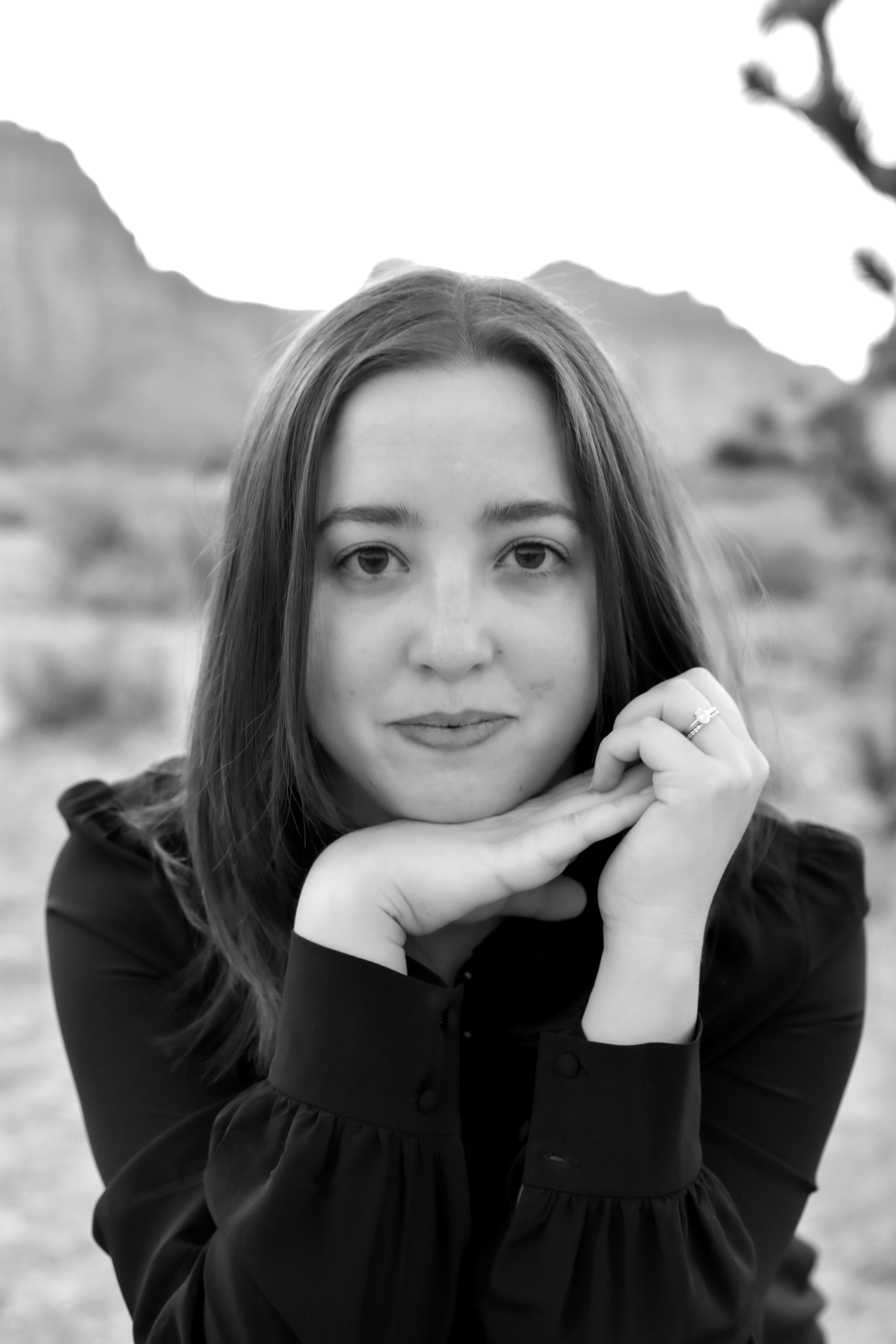
Chrissy Martin is the author of Whole, Holy, Hot (Write Bloody, April 2026). She is an Assistant Professor of English at Centenary College of Louisiana. She holds a PhD in poetry from Oklahoma State and an MFA in Poetry from Columbia College Chicago. She is the Poetry Director and a founding editor for Arcturus. Her work has appeared in Harpur Palate, Cherry Tree, Cream City Review, and the minnesota review. She lives with her partner, Ryan, and teacup poodle and muse, Toby. Find her at www.chrissymartinpoetry.com.


Comments